For Immediate Release: Dec 4, 2025
Contact:
Ren Brownell, Rios to Rivers Media Contact
ren@residenttrout.com
+1 (530) 598-8255
Indigenous Youth Return from COP30 with a Message for Climate Resilience: “Free-Flowing Rivers Are the Missing Link”
Removing dams heals rivers, reduces methane emissions and creates carbon sinks, offering a new path to curbing greenhouse gas emissions and climate resilience.
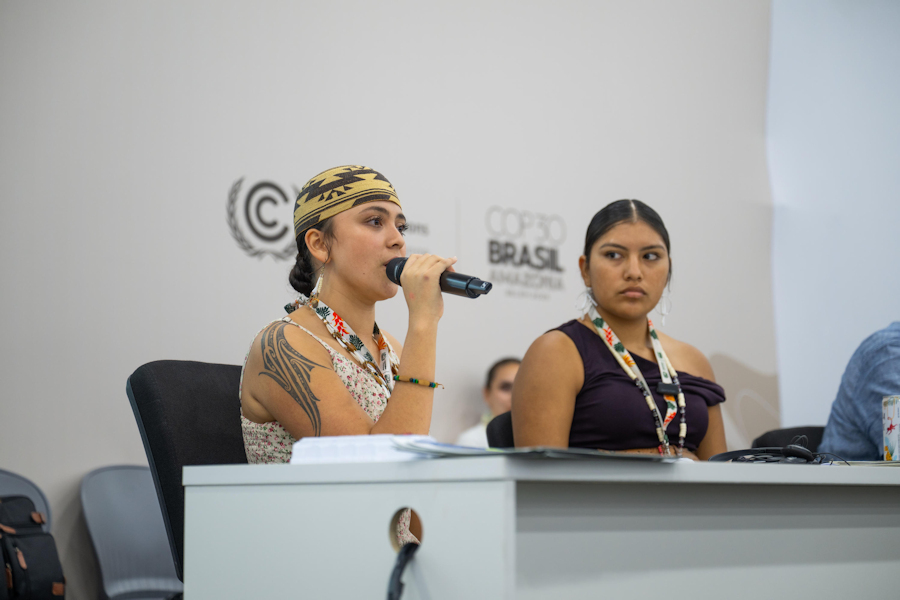
KLAMATH BASIN, CA/OR – Following the conclusion of the UN Climate Change Conference (COP30) in Belém, Brazil, the Ríos to Rivers’ Paddle Tribal Waters youth delegation has returned to the United States with a renewed mission: to champion river restoration as a verified, nature-based solution to the climate crisis. Fresh from the historic first descent of the undammed Klamath River, the Indigenous youth delegation traveled to Brazil not just to advocate for Indigenous rights, but to propose a proven path forward.
“We went to COP30 to advocate for a different approach to climate action,” said Keeya Wiki, a Yurok and Maori person and Paddle Tribal Waters alumna. “For too long, the conversation has focused on technology to fix the climate, but the success of dam removal on the Klamath River has shown us that nature has an incredible ability to heal itself once it is given the chance.”
While the Klamath River dams were removed to improve water quality and create fish passage to historic habitat, a recent report shows that it has also served as a path to eliminate greenhouse gas emissions and restore natural carbon sinks. The report (click here to read), prepared by Tell The Dam Truth using the All-Res Modeling Tool, estimates the cradle-to-grave, life cycle greenhouse gas (GHG) emissions caused by the hydropower project. The four Klamath River Dam facilities that were removed (JC Boyle, Copco 1, Copco 2, and Iron Gate) are estimated to have caused the emission of approximately 275,000 metric tons of CO2e/year over their lifetime. That is the equivalent of burning 31,000,000 gallons of gasoline for every year of their existence.
“For decades, we overlooked the invisible costs of hydropower. The removal of dams and their reservoirs is not just an act of river restoration” said Gary Wockner, Director of Tell the Dam Truth, which is funded by Holdfast Collective, “It is a tool for reducing the impacts of climate change.”
Over the last two decades, knowledge about the environmental impacts of dams and reservoirs has increased significantly, showing they cause the emission of hundreds of millions of tons of greenhouse gases annually, with methane, an extremely potent climate pollutant, being the largest contributor. Although uncertainty remains, current research shows that reservoirs are a significant human-caused source of methane worldwide, comparable in scale to other major sectors such as rice cultivation, methane leaks from coal mining, and biomass burning. (Global Carbon Project 2024)
“The Klamath River shows us that we can still fix things. We are seeing water temperatures drop and native plants return. Restoring free flowing rivers is what real climate resilience looks like.” said Ríos to Rivers Global Coordinator, Hayley Stuart. “We are inviting the other communities and world leaders to look at rivers like the Klamath not as a local success story, but as a global solution that should be applied to every impounded river.”
###
Editor’s Notes: